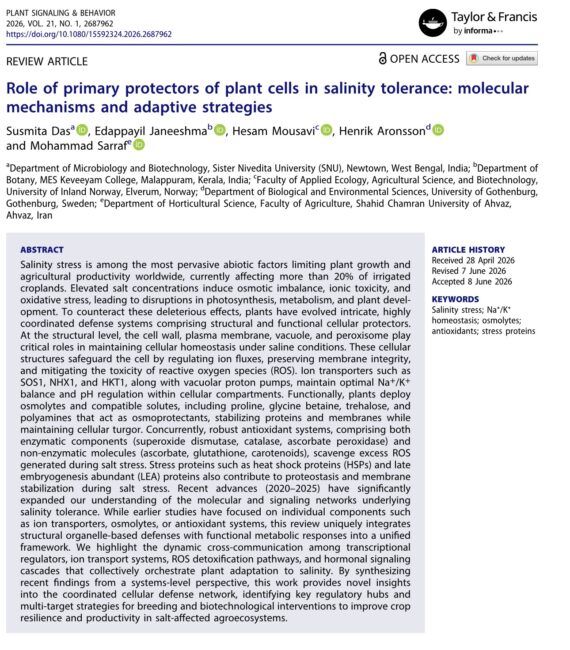
Publication Alert: Role of Primary Protectors of Plant Cells in Salinity Tolerance: Molecular Mechanisms and Adaptive Strategies
We are pleased to share a new open-access review by Susmita Das, Edappayil Janeeshma, Hesam Mousavi, Henrik Aronsson, and Mohammad Sarraf, published in Plant Signaling & Behavior (2026, Vol. 21, No. 1).
Soil salinization is one of the most pressing abiotic challenges facing global agriculture today, currently affecting more than 20% of irrigated croplands worldwide. Elevated salt concentrations disrupt plant cells through osmotic imbalance, ionic toxicity, and oxidative stress, ultimately impairing photosynthesis, metabolism, and overall plant development. In response, plants have evolved highly coordinated, multi-layered defense systems — and this review offers an integrative synthesis of how those systems work together.
This review brings together two strands of salinity-tolerance research that are usually treated separately: the structural defenses of the plant cell (cell wall, plasma membrane, vacuole, peroxisome) and the functional/metabolic responses (osmolytes, antioxidant systems, stress proteins). Structural cellular defenses — the cell wall, plasma membrane, vacuole, and peroxisome — regulate ion fluxes, preserve membrane integrity, and mitigate reactive oxygen species (ROS) toxicity. Key players here include ion transporters such as SOS1, NHX1, and HKT1, along with vacuolar proton pumps that maintain Na⁺/K⁺ balance and pH homeostasis. Functional and metabolic responses, include osmoprotectants (proline, glycine betaine, trehalose, polyamines) that stabilize proteins and membranes while preserving cellular turgor; enzymatic and non-enzymatic antioxidant systems (superoxide dismutase, catalase, ascorbate peroxidase, ascorbate, glutathione, carotenoids) that scavenge excess ROS; and stress proteins such as heat shock proteins (HSPs) and late embryogenesis abundant (LEA) proteins that support proteostasis and membrane stability.
By synthesizing recent advances, the authors map the dynamic cross-talk among transcriptional regulators, ion transport systems, ROS detoxification pathways, and hormonal signaling cascades — identifying key regulatory hubs and proposing multi-target strategies for breeding and biotechnological interventions aimed at improving crop resilience and productivity in salt-affected agroecosystems.
This work is closely aligned with SUSTAIN’s core mission of advancing the sustainable use of salt-affected lands, and the COST Action SUSTAIN-CA22144 collaborative framework contributed to the conceptualization and preparation of this manuscript.
Congratulations to all the authors, and particularly to our SUSTAIN network members Henrik Aronsson (University of Gothenburg, Sweden) and Hesam Mousavi (University of Inland Norway) on this contribution.