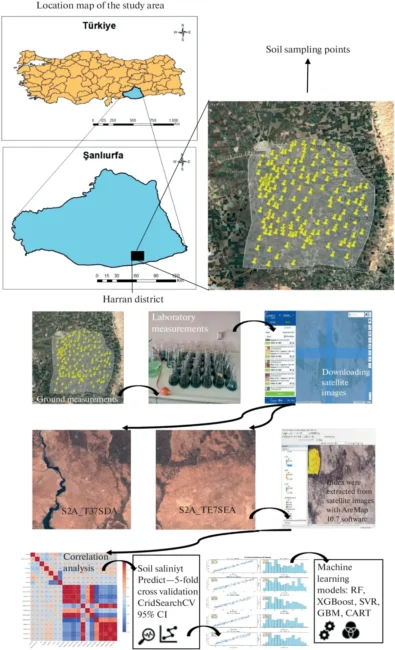
We are pleased to share a new publication by SUSTAIN members, authored by F. Kaplan, A. V. Bilgili, and M. Kılıç, and published in Eurasian Soil Science (Springer, Volume 59, 2026).
“Monitoring Soil Salinity in the Harran Plain: A Comparative Analysis of Machine Learning Algorithms Using Two Different Scenarios with Sentinel-2 Data”
Soil salinization is one of the most pressing threats to agricultural productivity and land sustainability worldwide. This study, conducted in the Harran Plain of southeastern Turkey — a major agricultural region — addresses the urgent need for scalable, cost-effective tools to map and monitor salt-affected soils.
The authors benchmarked five machine learning algorithms — Random Forest (RF), Extreme Gradient Boosting (XGBoost), Support Vector Regression (SVR), Gradient Boost Machine (GBM), and Classification and Regression Trees (CART) — under two data scenarios: one integrating all available parameters, and one relying exclusively on Sentinel-2 satellite spectral indices.
Key findings:
- The Random Forest algorithm consistently outperformed all other models across both scenarios, achieving an R² of 0.87 using the full parameter set and 0.83 using Sentinel-2 indices alone — demonstrating strong predictive power even with freely available satellite data.
- SHAP (SHapley Additive exPlanations) analyses validated the models’ reliability and confirmed the robustness of the RF approach, lending interpretability to the predictions.
- Sentinel-2-based models proved to be a viable, low-cost alternative to traditional, field-intensive salinity measurement methods, opening the door for large-scale, near-real-time soil health monitoring.