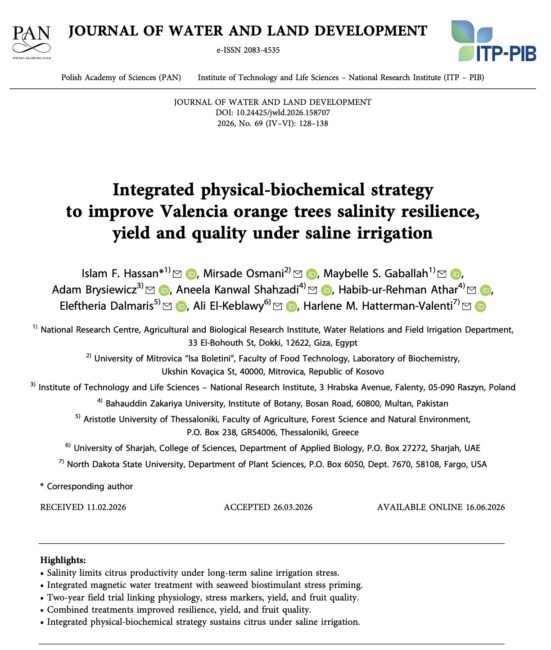
New publication: Integrated physical-biochemical strategy to improve Valencia orange trees salinity resilience, yield and quality under saline irrigation
A new open-access study co-supported by the SUSTAIN COST Action (CA22144) has been published in the Journal of Water and Land Development.
The work tests a chemical-free approach to keeping citrus productive where groundwater is increasingly saline — a growing problem for orchards in arid and semi-arid regions. Over two field seasons, the authors combined magnetically treated saline water (MTSW) with a foliar seaweed biostimulant (Ascophyllum nodosum) on Valencia orange (Citrus sinensis) grafted onto ‘Volkamer’ lemon, and compared it against untreated saline water and MTSW alone.
Key findings:
- The combined treatment improved vegetative growth, leaf relative water content, and soluble carbohydrate accumulation, while lowering stress markers (proline and malondialdehyde).
- These physiological gains carried through to yield and quality: higher fruit yield, greater juice percentage, and higher total soluble solids, with reduced titratable acidity relative to the saline control.
- The integrated treatment outperformed MTSW alone across both seasons, pointing to a reinforcing effect between altered water properties and biostimulant-driven metabolic regulation.
The findings suggested that pairing magnetic water treatment with a seaweed biostimulant can offer a scalable, low-input strategy for sustaining citrus productivity under saline irrigation.