Speakers Abstracts
1) Introduction to soil salinity, sodicity and diagnostic techniques
Karim Ben Hamed
Manouba School of engineering (MSE), University of Manouba. Tunisia
[email protected]
Soil salinity and sodicity are among the most pervasive forms of land degradation threatening agricultural productivity and ecosystem resilience. Salinity results from the excessive accumulation of soluble salts, while sodicity arises from disproportionate sodium concentrations on soil exchange sites, leading to structural collapse and impaired infiltration. Accurate diagnosis is fundamental to management: electrical conductivity (EC) quantifies salinity, whereas sodium adsorption ratio (SAR) and exchangeable sodium percentage (ESP) are key indicators of sodicity. Complementary tools such as pH measurement, remote sensing, and geospatial analysis enhance monitoring across scales. This session outlines the definitions, impacts, and diagnostic thresholds of saline and sodic soils, emphasizing the integration of classical laboratory techniques with modern monitoring approaches to guide reclamation strategies and ensure sustainable agroecosystem management.
2) Artificial Intelligence supporting Earth Observation for climate change and environment analysis
Imed Riadh Farah
Manouba School of engineering (MSE)
[email protected]
The climate crisis is a present reality, marked by rapid ice loss, ocean warming, and extreme weather. While Earth observation (EO) systems generate vast data streams, the challenge lies in converting them into actionable knowledge for resilience. This talk highlights how Artificial Intelligence (AI) is transforming EO, bridging data and decision-making through applications such as extreme weather prediction, real-time wildfire and flood detection, optimized water use, and carbon mapping. Case studies include AI-driven precipitation–vegetation analyses in the Mediterranean and automated soil moisture tools for arid regions. Remaining challenges—data gaps, interpretability, and computational costs—are addressed alongside future directions: hybrid physics–AI models, open data ecosystems, and sustainable AI. Together, AI and EO enable a paradigm shift toward proactive climate action.
3) Machine Learning foundation
Mohamed Farah
Institut Supérieur des Arts et Métiers de la Manouba (ISAMM)
[email protected]
This course introduces the core concepts of machine learning for environmental and geospatial data. It covers data preparation, feature engineering, supervised learning (classification/regression), model selection, and evaluation metrics. Emphasis is placed on practical understanding of algorithms commonly used in Earth observation applications (e.g., Random Forest, SVM, Gradient Boosting).
4) Machine Learning for Remote Sensing: Methods and use cases
Ali Ben Abbes
Manouba School of engineering (MSE)
[email protected]
This course focuses on how machine learning is applied to remote sensing data (multispectral, SAR, and time series). Participants learn remote sensing feature extraction (spectral indices, texture, temporal descriptors), multi-sensor fusion principles, and typical pipelines for mapping and monitoring tasks. Use cases include vegetation stress, drought indicators, soil moisture proxies, and land degradation/salinity signals.
5) Applications and case studies (Hands-on)
Manel Rhif
National School of Computer Science (ENSI)
[email protected]
This course is practice-oriented and built around real-world case studies. Participants develop end-to-end workflows: data access (e.g., Sentinel/Landsat), preprocessing, training ML models, generating thematic maps, and validating results with reference data. The course concludes with interpretation, reporting, and discussion of limitations, reproducibility, and deployment in decision-support contexts.
Speakers/Trainers/ (short biography)
Imed Riadh FARAH (Male), Full Professor of Computer Science and a Senior Researcher with the Laboratory of research in software engineering and applied, distributed and intelligent informatics (RIADI). Since 2022, he has served as Head of the Manouba School of Engineering at the University of Manouba, Tunisia. From 2011 to 2016, he was Director of the Multimedia School. In recognition of his scholarly impact, he received the University of Manouba’s Local Researcher Award as the Most Cited Researcher in 2022. His research spans artificial intelligence, remote sensing, medical image processing, and pattern recognition.
Karim BEN HAMED (Male), Ph.D. in Biological Engineering, is Professor of Higher Education at the National School of Engineering of Manouba (MSE), University of Manouba. With over two decades of research experience at the Biotechnology Center of Borj Cédria (CBBC), he specializes in plant adaptation to salinity and halophytes and has authored more than 70 scientific publications. He has coordinated and contributed to international projects on soil remediation and saline resource valorization (PRIMA, Biodiversa+, COST, ICOOP, CMCU, among others). His teaching spans genetics, plant biology, ecotoxicology, and since 2024, courses in English on Biology, Ecophysiology, Biochemistry and Biotechnology at MSE. Beyond academia, he is actively engaged in Tunisian civil society through leadership roles in several environmental and community associations.
Ali BEN ABBES (Male) is an Assistant Professor of Computer Science and Director of Studies & Internships at the Manouba School of Engineering (MSE), Manouba University, Tunisia. His research focuses on GeoAI and Earth Observation, including drought forecasting, land-use and land-cover mapping, soil moisture estimation, and poverty/well-being mapping. He is actively involved in international collaborations and projects aligned with the UN Sustainable Development Goals, while teaching AI, data science, and image processing and supervising several PhD and engineering students.
Manel RHIF (Female) is an Assistant Professor of Computer Science at the National School of Computer Science(ENSI), University of Manouba, Tunisia. Her research focuses on GeoAI and Earth Observation, including drought forecasting and vegetation monitoring. She is actively involved in international collaborations and projects aligned with machine learning and remote sensing.
Mohamed FARAH (Male) is Associate Professor at the Higher Institute of Arts and Multimedia (ISAMM), University of La Manouba, Tunisia, and a researcher in the SIIVT team at the RIADI Laboratory. He holds a Habilitation Universitaire in Computer Science from ENSI (2019) and a Ph.D. from Paris Dauphine University (2006). His research focuses on Computer Vision, Artificial Intelligence, and Multimodal Data Fusion, with applications in Remote Sensing and Medical Imaging. His key interests include geospatial intelligence, traffic congestion prediction, brain disease detection using EEG, emotion recognition, protein modeling, dimensionality reduction, and explainable AI.
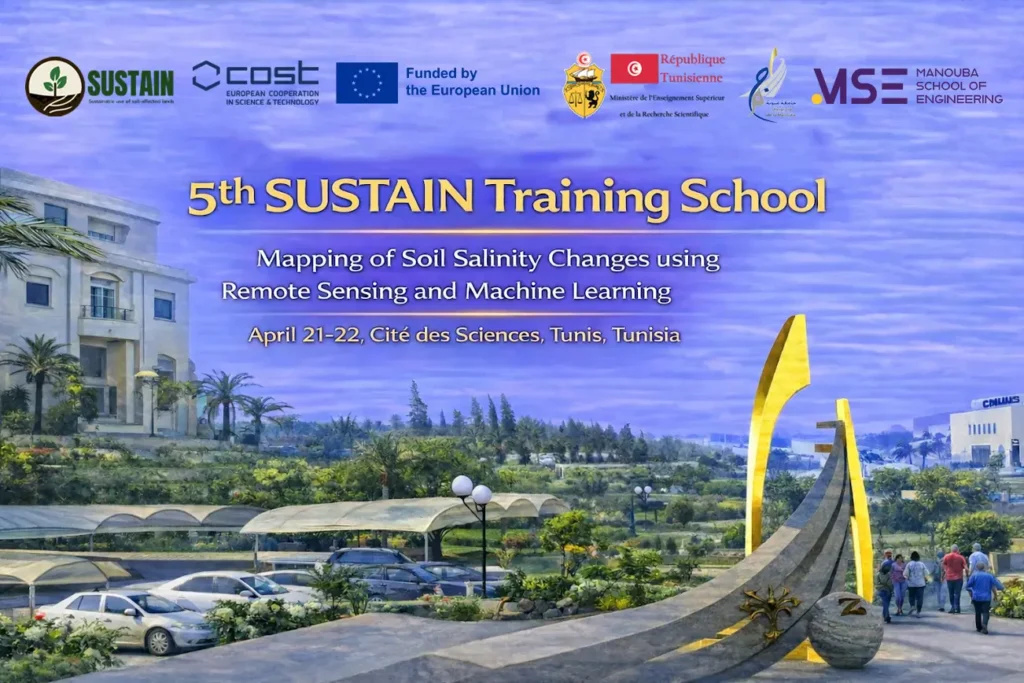
 This international training school brought together a diverse group of students, researchers, and professionals from multiple countries, creating a unique environment for knowledge exchange and capacity building.
 Focused on “Mapping Soil Salinity Changes using Remote Sensing and Machine Learning”, the program combined:
 Participants benefited from an immersive experience at the intersection of Earth Observation, AI, and environmental sustainability, strengthening both technical skills and international networks.
 Beyond training, the school fostered strong connections across countries and disciplines, reinforcing the spirit of the COST Action SUSTAIN CA22144 community.
 A sincere thank you to all trainers, participants, and partners for making this edition a true international success.


