WG1 Webinar – Soil Salinity: Monitoring and Management Approaches
COST Action CA21144

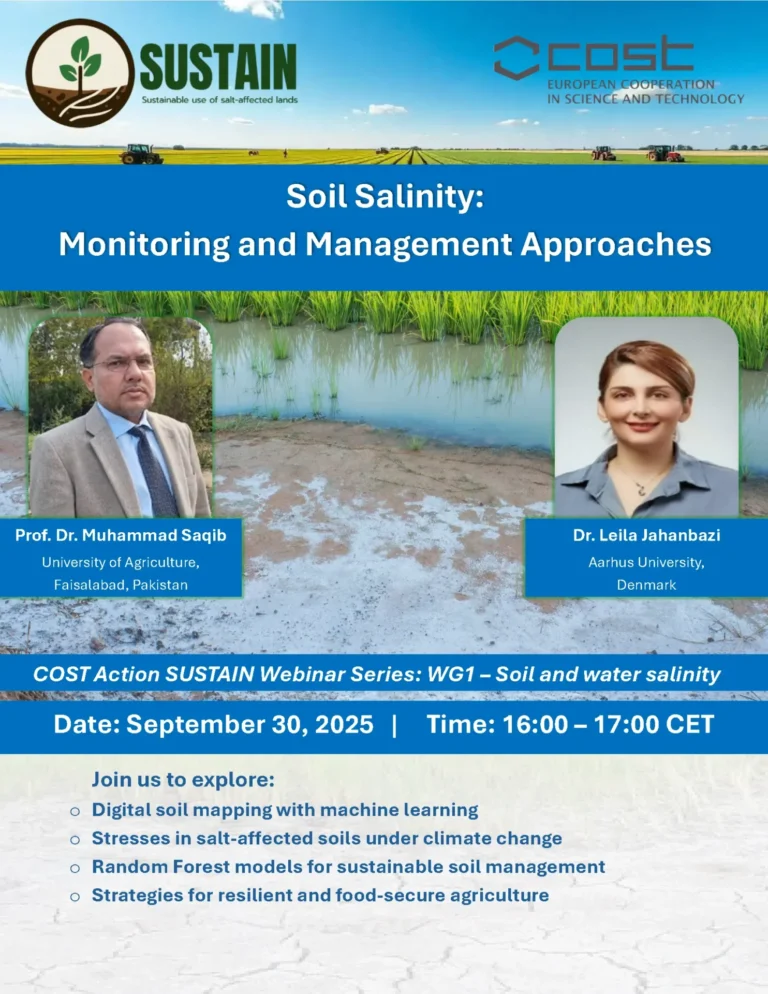
WG1 Webinar – Soil Salinity: Monitoring and Management Approaches
📢 We are pleased to invite you to the upcoming webinar organized by Working Group 1 (WG1) of COST Action SUSTAIN – Soil Salinity: Monitoring and Management Approaches
This interactive session is designed to empower early-career researchers (ECRs) by fostering knowledge exchange, practical guidance, and peer-to-peer networking in a supportive environment.
🔍 Introduction & Goal
Working Group 1 of COST Action SUSTAIN focuses on advancing methodologies for soil salinity monitoring and management, with the goal of identifying existing gaps, improving digital soil mapping techniques, and better understanding co-occurring stresses in saline soils. This webinar brings together two distinguished researchers who will share insights from field-based studies and modeling approaches, offering perspectives highly relevant for sustainable agriculture and soil management under climate change.
📅 Event Details
- 🗓 Date: September 30, 2025
- 🕓 Time: 16:00–17:00 CET
- 📍 Location: Online via Zoom
- 📩 Registration link:
https://vu-live.zoom.us/webinar/register/WN_nRPIhxWNRNCiPO79UN77iQ
Speakers and Presentations
🎤 Prof. Dr. Muhammad Saqib
Institute of Soil and Environmental Sciences, University of Agriculture, Faisalabad, Pakistan
Presentation Title: Unraveling the Interplay of Co-Occurring Stresses in Salt-affected Soils: A Comprehensive Analysis
Abstract:
“Salt affected soils” encompass saline soils which are high in soluble salts, and sodic soils which are high in exchangeable sodium and alkalinity, and low in calcium availability. The state of salt-affected soils becomes complicated by the co-occurrence of other climate induced and environmental stresses including drought, waterlogging, heavy metals, air pollution, and high/low temperatures. Interplay of Co-Occurring Stresses in Salt-affected Soils determine the ultimate challenge for the plants. Nutrient dynamics are changed in these soils leading to nutritional deficiencies and toxicities. The global climate change has increased the intensity and frequency of adverse events like droughts, floods and high/low temperatures. These events mostly result in an additive deletorius effects on plant growth, yield and survival. This webinar will present a Comprehensive Analysis of Interplay of Co-Occurring Stresses in Salt-affected Soils.
🎤 Dr. Leila Jahanbazi
Post doc Fellow, Agroecology department, Aarhus University, Denmark
Presentation Title: Soil Salinity Digital Mapping using Random Forest Model
Abstract:
Soil salinization is a prevalent form of land degradation in arid regions which threatens soil productivity, agricultural sustainability, and food security. Since, the salinity can be caused by anthropogenic activities, in addition to natural sources, many studies have been conducted to study the spatial and temporal changes and their constituents. Monitoring and evaluating spatiotemporal dynamics of soil salinity are important due to high variability of salinity. The classical methods of study of soil salinity are time and cost-consuming compared to digital soil mapping. Monitoring and lab works in digital soil mapping could be reduced. Purpose The purpose of this study was characterizing and mapping secondary salinity by using random forest model at a field scale for precision and sustainable management of saline soils in study area.
About the Speakers
Dr. Muhammad Saqib is a soil and environmental scientist having an excellent academic and professional record with distinctions. He is Georg Forster Senior Research Fellow of the Alexander von Humboldt (AvH) Foundation, Germany, fellow of German Academic Exchange Service (DAAD), fellow of Japan Society for the Promotion of Science (JSPS) and fellow of International Foundation of Science (IFS, Sweden). He has worked at the Interdisciplinary Research Center for Environmental Research, Justus Liebig University, Giessen, Germany, at the Biotechnology Research Centre, University of Tokyo, Tokyo, Japan and the Biology Department, University of York, York, UK. He has been working on sustainable land use management, plant eco-physiology and saline agriculture in the context of soil and water stresses, particularly salinity and sodicity, environmental pollution, soil carbon management and climate change. He works to understand and exploit soil-plant-water system under changing climatic conditions and to devise solutions not only for the efficient and sustainable utilization of these resources but also for the rehabilitation/remediation of the degraded land resources – salt-affected soils. He is a member of International Network for Salt-affected Soils (INSAS, FAO), a Life Member of Soil Science Society of Pakistan, and has been a member of German Society of Plant Nutrition (Germany). Dr. Saqib strives to achieve sustainable development goals through sustainable use of salt-affected lands. He works as an editor and reviewer with international impact journals.
Dr. Leila Jahanbazi is a Postdoctoral Researcher at Aarhus University with a PhD in Soil, Land & Environmental Management. With over a decade of experience in agroecology, soil science, Soil health and green house gass emission, her work focuses on remote sensing, climate change, GHG emission, soil salinity and digital soil mapping. Dr. Jahanbazi is currently leading research on Glacial Rock Flour project, aiming to enhance crop yields, reduce GHG emission, and promote carbon sequestration for climate change mitigation. Proficient in data analysis tools, she combines field expertise with advanced machine learning and satellite imagery to support soil health and sustainable agriculture.